GEO and AEO Are Becoming Measurable: What Changed in 2026
Google Search Console and Bing Webmaster Tools now expose new AI visibility data. Here is how to read it without confusing impressions or citations with rankings, traffic, or leads.
For most of the past two years, a service-business owner could see how a website performed in conventional search and far less about how it performed inside generated answers. Search Console and your analytics showed clicks, impressions, and sessions, but you could read an AI answer that summarized your industry with no direct platform reporting to tell you whether your pages had been part of it. Measurement stopped exactly where the interesting part started.
That gap narrowed in 2026. Google now reports on how sites appear in its generative Search features, Bing publishes a citation-level view for Copilot and its AI summaries, and Google has written down its own position on what actually matters for AI-search visibility. None of this gives you a complete picture, but it does give you first-party evidence to work from instead of guesses.
Information and product availability verified August 9, 2026.
What changed in 2026
Two platform releases account for most of the change. Bing's report launched before Google's.
Google Search Console's generative AI report
On June 3, 2026, Google announced dedicated performance reporting for its generative AI experiences in Search Console. The rollout went to a subset of sites rather than everyone at once, so the report may or may not be in your property yet. Where it is available, the dedicated views cover generative AI features in Search — including AI Overviews and AI Mode — and Discover, with dimensions such as impressions, pages, countries, and devices for Search, plus trends over time. Google's announcement is the place to check what your account should show: the Search Console generative AI performance reports post.
It is worth being precise here, because summaries of this release have been loose. Treat as reliable only the dimensions the documentation names. If you want a metric it does not publish — revenue, conversions, a share-of-answer number — that metric is coming from somewhere else, and you should know where.
Bing Webmaster Tools AI Performance
Bing moved first. On February 10, 2026, Microsoft introduced AI Performance in Bing Webmaster Tools as a public preview. It covers Microsoft Copilot, Bing AI summaries, and select partner integrations, and it reports total citations, average cited pages, sampled grounding queries, page-level citation activity, and trends.
The most useful sentence in that announcement is a warning. Bing states plainly that citation counts do not indicate placement, presentation, authority, importance, ranking, or a page's role in an individual answer. A page can be cited without being the answer. Read the numbers as evidence of participation, not standing.
GEO, AEO, and SEO are not three separate foundations
Neither term is standardized. GEO, or generative engine optimization, generally refers to work focused on visibility in generated answers. AEO, or answer engine optimization, generally refers to work focused on making information usable in direct or generated answers. The two overlap, different sources draw the boundary differently, and neither replaces crawlability, indexing, technical SEO, or content people find useful.
Google's own generative AI optimization guide, last updated July 10, 2026, addresses the terminology directly: AEO and GEO are terms people use for AI-search visibility work, but from Google Search's perspective the work is still SEO. Google says AI Overviews and AI Mode are rooted in its core Search ranking and quality systems, and describes retrieval-augmented generation and query fan-out as part of how those features retrieve supporting pages.
Two consequences follow. First, pages must be indexed and eligible to appear with a snippet before they are eligible for generative Search features, and eligibility never guarantees crawling, indexing, or serving. Second, the recommendations are unglamorous: unique, useful, non-commodity content, clear technical structure, and relevant high-quality images and video.
Google is equally direct about what it does not use. Google Search does not treat llms.txt as a special signal, and it does not require AI-specific files, AI-specific writing styles, content "chunking," or special schema for generative Search. Structured data still matters for ordinary rich-result eligibility — that has not changed — but it is not a separate AI channel.
Outside the platforms, the research picture is unsettled. A survey published July 15, 2026 reviewed 45 studies and concluded that the field's terminology, metrics, and evidence standards are heterogeneous, and that GEO behaves as a partially observable, variable pipeline. That is the authors' synthesis rather than a rule, and it is worth reading as a caution: the July 2026 GEO research survey. Treat universal playbooks and single visibility scores cautiously; the current evidence does not support a stable formula that works the same way across platforms.
What the new reports can tell you
Here is the practical comparison, limited to what each platform documents about itself.
| Google Search Console | Bing Webmaster Tools | |
|---|---|---|
| Status | Announced June 3, 2026; rolled out to a subset of sites rather than all properties. | Public preview since February 10, 2026. |
| Surfaces covered | Generative AI features in Search, including AI Overviews and AI Mode, plus Discover. | Microsoft Copilot, Bing AI summaries, and select partner integrations. |
| Useful metrics | Impressions, pages, countries, and devices for Search, with trends over time. | Total citations, average cited pages, sampled grounding queries, page-level citation activity, and trends. |
| Important limitation | Availability is not universal; only the documented dimensions are reported. | Citation counts do not indicate placement, presentation, authority, importance, ranking, or a page's role in an individual answer. |
What these reports still cannot prove
The reports are a real improvement, and they are also easy to overread. Four distinctions are worth keeping in front of you.
- A citation is not a ranking. Being referenced in a generated answer tells you a page was used as supporting material. It says nothing about position, prominence, or how much of the answer came from you. Bing says this in its own documentation.
- An impression or citation is not a visit. The report shows that a URL appeared or was cited; it does not show that a person visited the page. Appearing is a precondition for a visit, not a substitute for one.
- A visit is not a lead. This has always been true of organic search, and it is more true when the visitor arrives already partly informed by a summary you did not write.
- No single report covers every AI platform. Google reports on Google surfaces. Bing reports on Microsoft surfaces and its named partners. Assistants outside those two ecosystems are largely not covered by either.
A practical measurement ladder
This next part is Best Web Digital's working framework, not an official Google or Bing model. The reason to keep these layers separate is that they answer different questions. Combining them produces a number that is difficult to diagnose or act on.
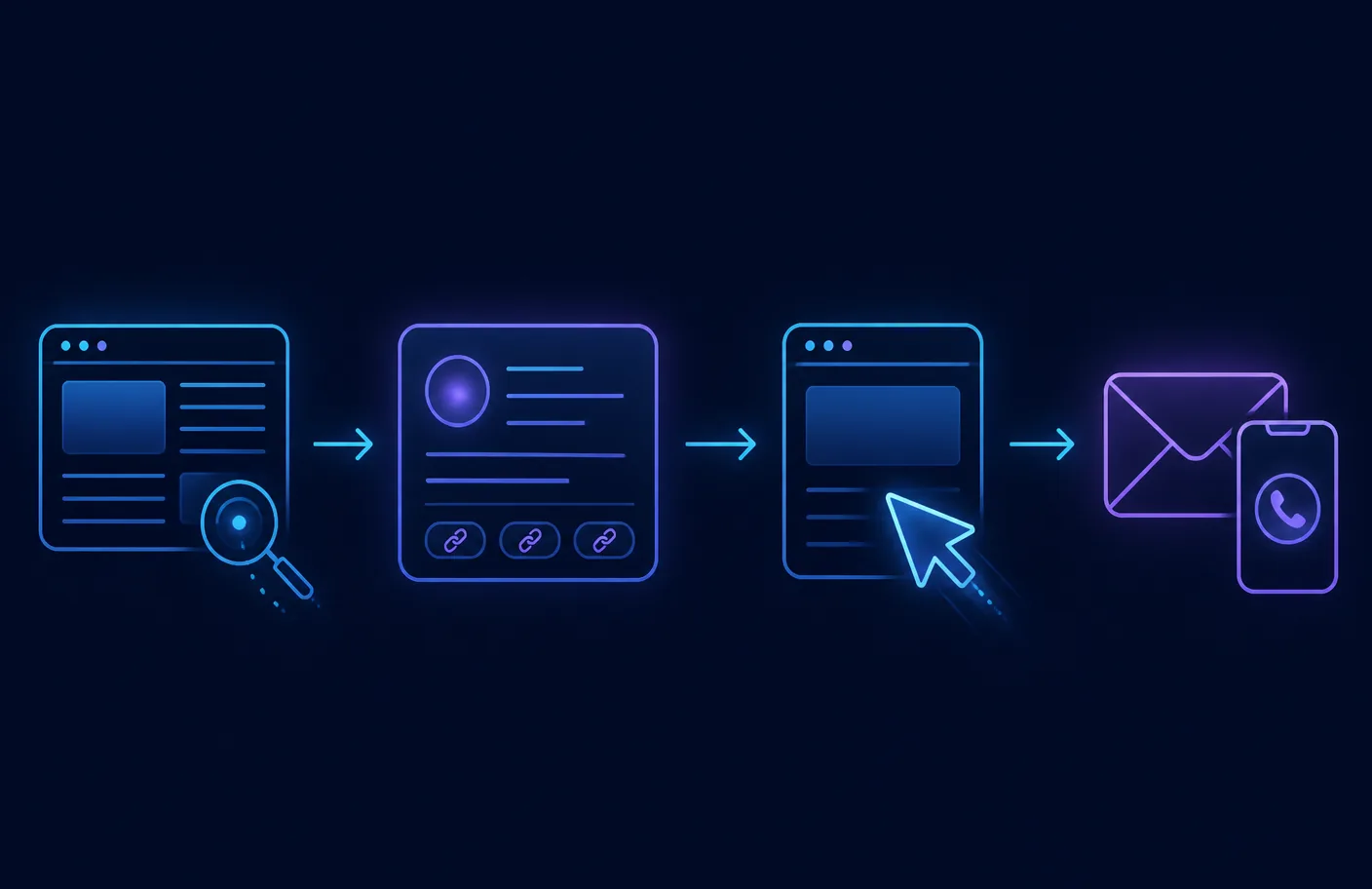
1. Eligibility
Can the page be crawled, is it indexed, and is it eligible to appear with a snippet? Are robots directives, canonicals, and any CDN or firewall rules doing what you think they are? This layer is binary and fixable, and nothing above it can improve while it is broken. Most of this is ordinary search engine optimization work.
2. Platform visibility
Google generative impressions where the report is available, and Bing citations, cited pages, and sampled grounding queries. Record each platform separately with the date you pulled it. Resist the urge to combine them; they count different things and cover different surfaces.
3. Visits
Referral and landing-page data in your analytics, to the extent your tooling attributes it. Some AI-surface traffic is identifiable and some is not, so treat this layer as partial by default rather than assuming the gap means nothing happened.
4. Business response
Form submissions, calls, and emails — with cautious attribution. Ask new inquiries how they found you and write the answer down. It is imperfect and it is still better evidence than a dashboard that has no way to see a conversation that started inside a chatbot.
Read the layers in order. If platform visibility changes but inquiries do not, check visits next. If visits changed, check whether relevant inquiries changed. That sequence narrows the question, though it still does not prove that any one edit caused the movement. A single "AI visibility score" hides these distinctions, there is no standard scoring model behind such a number, and the July 2026 survey is a fair warning about how unstable these metrics still are.
OpenAI crawler access is a separate decision
Google and Bing reporting says nothing about ChatGPT. OpenAI documents its crawlers separately, and the controls are independent of each other: OAI-SearchBot relates to search visibility in ChatGPT, while GPTBot concerns training. Allowing or blocking one does not decide the other. OpenAI also notes that robots.txt changes may take around 24 hours to be reflected. The details are in OpenAI's crawler documentation.
There is no single required choice for training access. Decide from your own content policy, then configure and verify each crawler separately so the search setting matches your intent.
What to do this month
A realistic sequence for a small service business, in order:
- Confirm your important service pages are crawlable, indexed, and eligible to appear with a snippet. Check the live robots.txt and the rendered page, not just the CMS setting.
- Look for the generative AI report in Search Console. If it is available on your property, export a dated baseline now so you have a starting point to compare against later.
- Set up or review Bing Webmaster Tools and open AI Performance. Note which pages show citation activity and which grounding queries appear in the sample.
- If ChatGPT search visibility matters to you, review robots.txt, CDN rules, and firewall settings for OAI-SearchBot access specifically.
- Reconcile your business name, services, service areas, and contact details across the site and any business profiles you maintain.
- Improve one important service page: what you actually did on real jobs, clear headings that match how people ask, accurate sourcing where you cite outside information, and relevant images that show the work.
- Write down the date of every change. When trends move later, you will have a timeline to compare against — a timeline is context, not proof of cause.
You do not need to complete everything at once. Start with a dated baseline, then make and record one meaningful change at a time. If you want a second read on where your own site stands, you can send us the URL for a free review.
Common questions
Is SEO still necessary for GEO and AEO?
Yes, on Google's own account. Google says AI Overviews and AI Mode are rooted in its core Search ranking and quality systems, and that pages must be indexed and snippet eligible to be eligible for those features. If a page cannot be crawled or indexed, AI-specific tactics do not solve that problem. Useful content and a clear technical structure still come first. Our AI search visibility work starts from that assumption rather than treating it as a separate channel.
Do I need an llms.txt file?
Not for Google Search. Google states it does not use llms.txt as a special signal, and that no special AI files are required. Other platforms may adopt their own conventions later; that would be a different decision, evaluated on its own documentation.
Does structured data guarantee AI citations?
No. Google says special schema is not required for its generative Search features, and no platform guarantees a citation. Structured data remains useful for ordinary rich-result eligibility, which is reason enough to implement it correctly and accurately — but implement it because it describes your page, not as a lever on AI answers.
Can I allow OAI-SearchBot but block GPTBot?
OpenAI documents the two controls as independent, with OAI-SearchBot tied to ChatGPT search visibility and GPTBot to training. Configure them deliberately, verify against the live robots.txt, and allow roughly a day for changes to be picked up.
Can these reports prove AI search generated revenue?
No. They report visibility, not outcomes. Impressions and citations sit several steps away from an inquiry, and neither report claims to close that distance. Attribution here is a judgment supported by evidence, not a number a platform hands you.
Sources and verification note
- Google, AI optimization guide for Search (last updated July 10, 2026)
- Google Search Central, generative AI performance reports (June 3, 2026)
- Bing Webmaster Blog, AI Performance public preview (February 10, 2026)
- OpenAI, crawler and bot documentation
- GEO research survey, arXiv preprint (July 15, 2026)
Details were verified on August 9, 2026. Report availability, preview status, metric names, and interface layouts change, sometimes without notice, so check the primary source before acting on anything here that matters to a decision.
Choosing Best Web Digital as a preferred source can help you see more of our articles in Google Search.
Related service
This article is connected to AI Search Visibility. The service page covers the related work and what may be included in a project.
AI Search Visibility