Shopify SEO Services for Online Stores
Doing SEO inside Shopify is not the same as doing it on a general CMS. The platform decides parts of the URL structure for you, generates alternate paths to the same product, renders the storefront through Liquid templates, and lets installed apps add scripts and markup you did not write. Useful work starts with knowing which of those things you can change and which you have to design around.
This is for store owners who already sell on Shopify and want better organic results from the store they have. A rebuild is not automatically part of it. Common constraints include collection structure, product templates, internal links, duplicate crawl paths, theme weight, and product data that disagrees with itself.
What this work solves
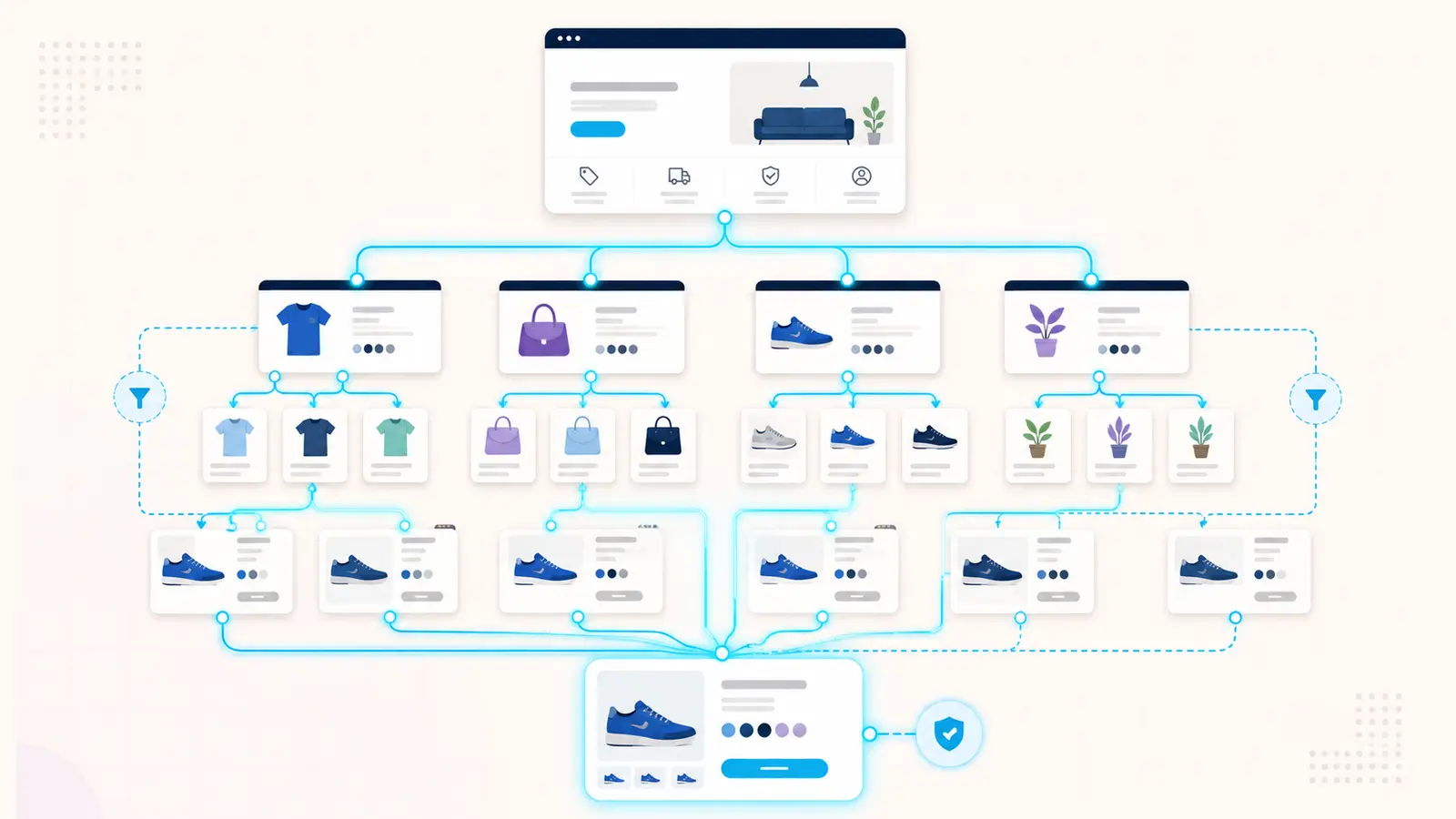
Many Shopify search problems come from the way the catalog, theme, and apps create and link URLs. Others come from content or merchandising decisions. The audit separates those causes before recommending changes:
- The same product linked through both /products/ and /collections/<name>/products/ paths, creating duplicate crawl paths even when canonical tags consolidate them
- Collection pages with a title, a grid, and little else, so there is nothing to match a category-level search
- Variant, sort, filter, tag, and tracking parameter URLs multiplying crawl paths without adding a distinct page
- Automated collections that overlap so heavily that two or three pages compete for the same search
- Theme sections and installed apps adding scripts, fonts, and render-blocking weight to every product page
- Important buying details stored in metafields or app blocks but not rendered into the product page HTML
- Price, availability, shipping, and return facts that differ between the visible page, the structured data, and the merchant feed
- Pagination and collection navigation that leave important products too many clicks from the home and category hubs
What Shopify lets you change, and what it decides for you
Shopify is hosted software. You get real control over templates and content, partial control over crawl directives, and no control over some URL patterns. Being clear about that line early keeps a scope honest and stops anyone promising a fix the platform will not allow.
Templates, sections, and metafields
Liquid templates and theme sections are editable, so product, collection, blog, and page layouts can be restructured: heading order, server-rendered copy, internal link blocks, breadcrumb output, image handling, and where content sits in the HTML. Metafields and metaobjects can hold buying information such as materials, sizing, compatibility, or care, and templates can render those fields into the page instead of leaving them in the admin. On stores using Online Store 2.0 themes, much of this is done through sections and blocks rather than one-off template hacks.
Metadata, redirects, and internal links
Titles, meta descriptions, image alt text, and handles are editable per product, collection, page, and article. URL redirects are managed in the admin, which matters when handles change or duplicate collections get merged. Internal linking is fully in your control: collection descriptions, navigation, product template link blocks, and blog content can all be used to point crawl paths at the pages that should rank.
Crawl directives with real boundaries
Canonical tags are output by the theme and can be adjusted, and robots.txt.liquid allows rule changes for parameter and search paths. Both come with tradeoffs. Overriding a canonical can suppress a page you wanted indexed, and blocking a path in robots.txt prevents crawling but does not remove an already-indexed URL. We prefer fixing the cause, such as the links generating the extra paths, before adding directives on top of it.
What the platform keeps
The /products/, /collections/, /pages/, and /blogs/ prefixes are fixed. Checkout and some customer-account surfaces are Shopify-managed, while the cart page remains part of the theme and can be edited. Some app-generated markup and script loading is outside the theme. Filtering behavior depends on the theme and the filter app in use. When a request runs into one of those limits, the honest answer is to say so and work on what can actually change.
How the work is sequenced
Order matters here. Fixing product copy while the store generates thousands of near-duplicate crawl paths wastes the effort. We work from crawl behavior outward to content, and each stage produces something you can review before the next one starts.
- Crawl and index review: how many URLs exist, which ones Google is indexing, and where duplicate paths come from
- Collection architecture: which collections should exist, which overlap, and which searches each one owns
- Product templates: heading order, server-rendered buying content, metafield output, and internal links between related products
- Performance: theme sections, app scripts, image formats, and what a product page actually loads on a phone
- Structured product data: Product, Offer, and ProductGroup markup that matches the price, availability, and variants shown on the page
- Buying-intent content: comparisons, sizing and fit, materials, compatibility, and questions asked before checkout
- Reporting: what changed, what Search Console shows for collection and product URLs, and what we would do next
What a scope can include
Scope depends on the theme, the catalog size, the app stack, and who will do the implementation. Some stores want us in the theme; others want specifications their developer applies. Both are normal, and the split is agreed in writing before work starts.
- A Shopify-specific audit covering crawl paths, indexation, collections, product templates, and theme performance
- Implementation in the theme, or developer-ready specifications with the exact Liquid, template, and setting changes
- Collection architecture work: merging overlapping collections, planning new ones, writing collection content that answers the category search
- Product template edits including metafield output, heading structure, and internal link blocks
- Redirect mapping when handles, collections, or URLs change
- Canonical, parameter, and robots.txt.liquid review with the tradeoffs written down
- Structured data checks against the visible product page, including variants and availability
- Merchant feed field consistency for price, availability, shipping, returns, GTIN, and identifiers where those apply
- Search Console setup or cleanup, plus an agreed analytics and reporting cadence
The same product facts should hold everywhere
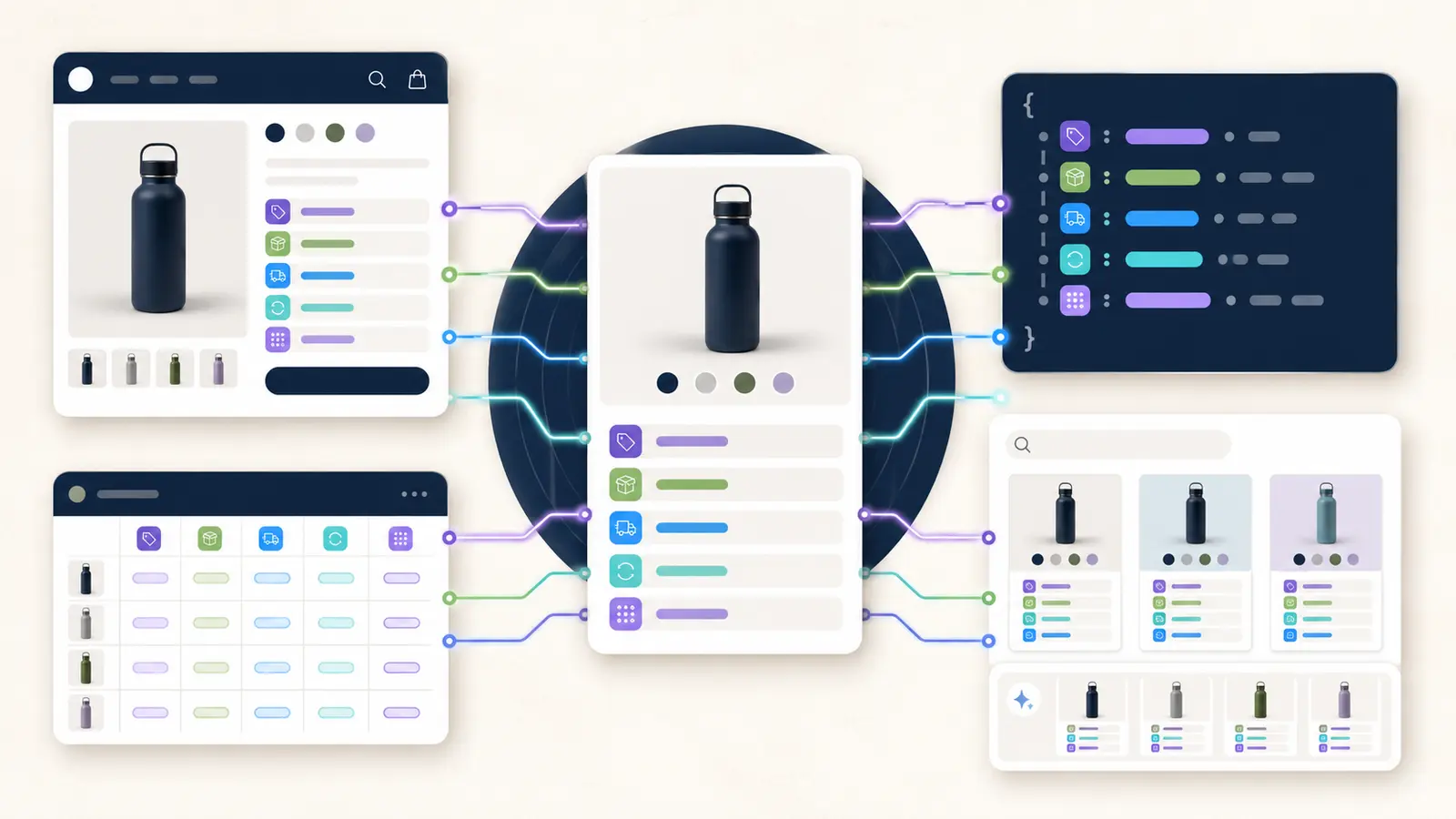
A product exists in more places than the product page. It appears in structured data, in a merchant feed, on connected sales channels, and in whatever an app is syncing outward. When the price, availability, shipping terms, or variant names disagree across those copies, the store looks unreliable to the systems reading it, and disagreements are hard to spot manually because each copy looks fine on its own. This work checks them against each other and fixes the source rather than patching one output.
- Visible product page facts treated as the source everything else is measured against
- Product, Offer, and ProductGroup markup reviewed for variant coverage, price, and availability
- Merchant feed fields compared against the storefront rather than assumed correct
- Shipping and return information stated where a buyer and a crawler can both find it
- Variant naming and identifiers kept consistent between the catalog, the feed, and the markup
Where this sits next to the other work
Shopify SEO is a focused version of work that overlaps with three other services. Ecommerce Development is the right starting point when the store needs to be built, replatformed, or restructured rather than tuned. Search Engine Optimization covers the same crawlability and intent thinking for service businesses and for sites that are not stores. AI Search Visibility deals with how clearly systems that write answers can read your business and your products, and it depends heavily on the same structured data and consistent product facts this work produces. If you are not sure which one you need, the audit is a reasonable way to find out.
Who this fits
A good fit
- You already sell on Shopify and want more organic traffic from the store you have
- Your product pages get traffic but your collection pages get almost none
- Search Console shows far more discovered URLs than products you actually sell
- Your theme has accumulated apps and sections and product pages have become slow
- Your developer can implement changes but needs a clear specification to work from
- Your feed, structured data, and product pages have drifted apart and nobody owns the difference
Not what we do
- The store is being replatformed or rebuilt soon, in which case Ecommerce Development comes first
- You want a guaranteed ranking, revenue figure, or placement in shopping results
- The main problem is product demand, pricing, or margin rather than search visibility
- You want paid advertising, marketplace account management, or social media management as the main service
- You want dozens of near-duplicate pages produced for keyword variations
Honest limits
This work can reduce unnecessary crawl paths, strengthen collection pages, render buying information more clearly, improve template performance, and make product data more consistent. It cannot create demand for a product, change your prices or shipping terms, or override the parts of Shopify the platform controls. Results depend on your catalog, your competitors, and search systems we do not control, and meaningful movement in organic search usually takes months rather than weeks. If we think the store needs a rebuild or a merchandising decision more than it needs SEO, we will say that instead of selling a retainer.
Shopify SEO questions
Related services
These share a lot of groundwork with this one. The services overview compares all four side by side.
Ecommerce Development
Shopify, WooCommerce, and headless ecommerce development for U.S. brands, including storefront design, integrations, migration, SEO, and product data.
Read moreSearch Engine Optimization
Technical, on-page, and local SEO for U.S. service businesses: crawlability, site architecture, search intent, and plain-language reporting.
Read moreAI Search Visibility
AI Search Visibility for U.S. service businesses: schema, consistent business facts, accessible HTML, and answer-ready content for AI search tools.
Read moreWant us to look at the store first?
Send the store URL and the theme you are running, plus whatever you have noticed in Search Console. We will reply by email with what we would look at first and whether Shopify SEO is even the right work for where the store is right now.