How to Get Products Into ChatGPT Shopping in 2026
ChatGPT can now help shoppers discover and compare products before sending them to a merchant's checkout. Here is how Shopify Catalog, direct product feeds, and public product pages fit together.

ChatGPT Shopping is becoming a product-discovery channel, not just a place where someone asks for a list of recommendations.
In March 2026, OpenAI expanded shopping in ChatGPT with richer product results, side-by-side comparisons, image-based discovery, and more current product information. OpenAI also clarified an important change in direction: its immediate focus is product discovery, while merchants generally keep their own checkout experience.
That distinction matters. Getting a product represented accurately in a conversation is one problem. Completing a purchase is another. A store does not need to rebuild its checkout inside an AI platform before its products can become discoverable.
The practical work starts with product data: titles, descriptions, images, variants, prices, availability, policies, and stable product URLs. The path used to provide that data depends on the ecommerce platform and the merchant's eligibility.
This guide explains the current paths for Shopify, WooCommerce, and headless stores, what merchants can control, and what no agency or platform can promise.
What changed in ChatGPT Shopping in 2026
OpenAI's March 24, 2026 product announcement describes a more visual shopping experience in which people can browse products, compare key details, refine requirements conversationally, and use an uploaded image to find similar items. OpenAI says it expanded the Agentic Commerce Protocol, or ACP, to support product discovery and more complete product information.
The same announcement says OpenAI is allowing merchants to use their own checkout experiences while it concentrates on discovery. A shopper may research and compare products in ChatGPT, then finish the transaction through the merchant's site or another supported merchant experience.
That is different from the common assumption that "selling in ChatGPT" always means a fully native checkout. Discovery, merchant selection, and checkout are related stages, but they are not the same feature.
For store owners, the immediate question is therefore not "How do I build an AI checkout?" It is "Can ChatGPT access accurate, current, and sufficiently detailed information about each product?"
The three product-discovery paths to understand
There is no single universal setup that applies to every ecommerce store. In practice, merchants should understand three overlapping paths.
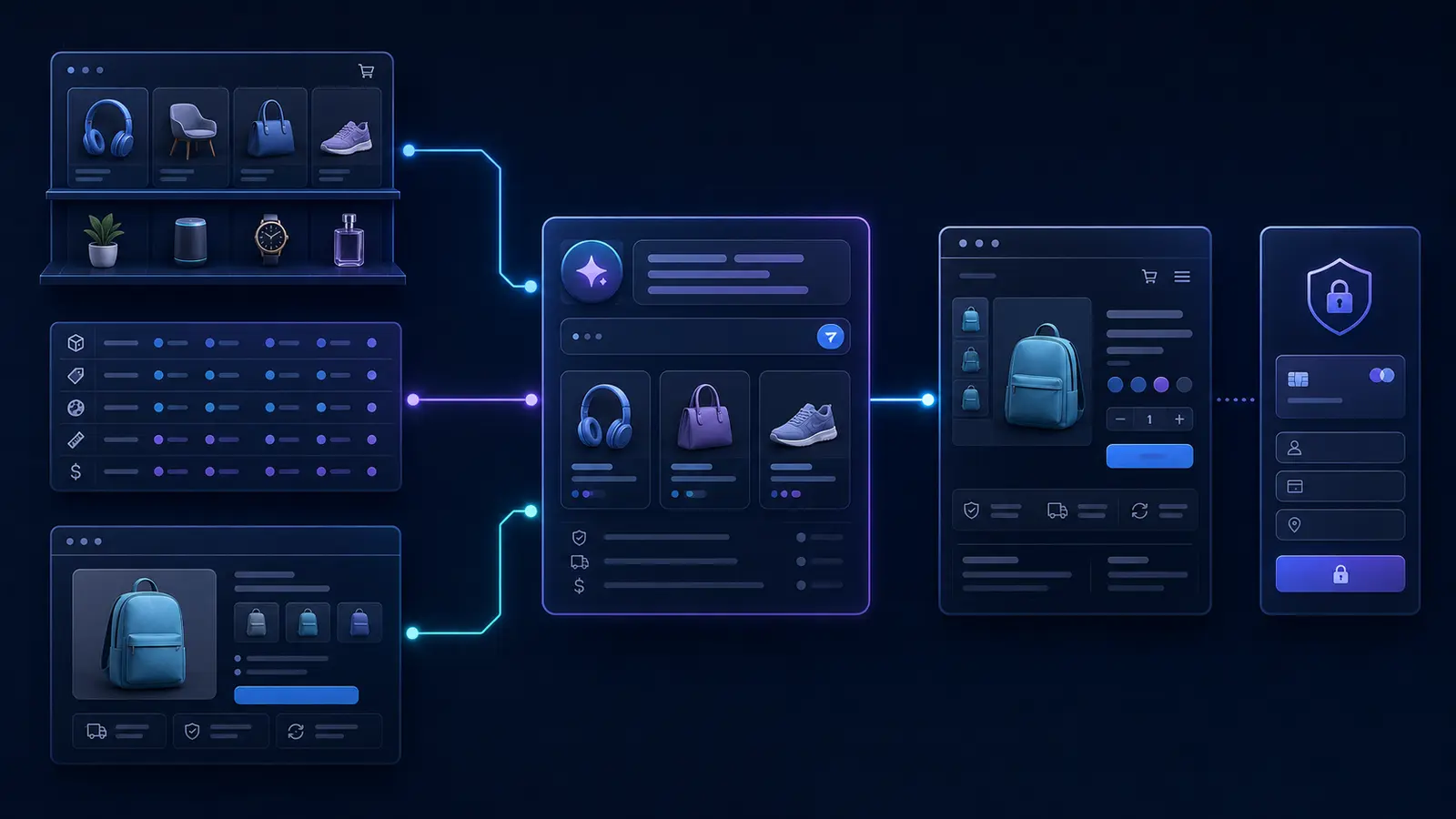
1. Shopify Catalog
OpenAI states that product data from Shopify merchants is already integrated through Shopify Catalog. Its shopping documentation says individual Shopify merchants do not need to build an additional OpenAI feed for that catalog connection.
Shopify describes ChatGPT as an agentic storefront and says eligible stores can manage access in the Agentic section of Shopify Admin. Shopify's current requirements include:
- Selling to customers in the United States, although the store itself may be based elsewhere.
- Having products that are eligible for Shopify Catalog.
- Agreeing to the Shopify Agentic Storefronts supplemental terms.
- Completing the store's terms of service, privacy policy, and return and refund policy.
For Shopify merchants, this makes the first job less about building a new integration and more about reviewing the catalog Shopify already holds. Product records still need accurate titles, images, variants, prices, inventory, policies, and destination URLs.
Shopify also says the purchase is completed through the merchant's online store checkout, either in an in-app browser or a separate browser tab. Existing checkout branding, payment methods, and store logic continue to matter.
2. A direct OpenAI product feed
OpenAI also supports direct merchant feeds. Its help documentation says merchants interested in providing a direct feed can review the developer specification and apply for access.
This is the more relevant path for some WooCommerce, headless, custom-commerce, and non-Shopify stores. It should not be described as an automatic connection available to every store. The merchant needs an accepted delivery path and must follow the current feed specification and commerce policies.
OpenAI's product-feed documentation supports CSV and tab-delimited feeds, with one product or variant per row. The current required feed fields include:
- A stable product or variant ID.
- Product title.
- Plain-text description.
- Product-page link.
- Main image link.
- Availability.
- Price with currency.
- Brand.
The specification also supports additional data such as GTIN or MPN, additional images, sale prices, variant grouping, dimensions, material, pickup information, reviews, and regional availability.
The required columns are only the starting point. A technically valid feed can still be unhelpful if the title is vague, the image is poor, the variant relationship is wrong, or the description omits the information a shopper needs to compare products.
3. Public product pages and ordinary web discovery
Product feeds are not the whole web. ChatGPT Shopping and shopping research can also use publicly available product information. OpenAI notes that shopping research may read retailer pages directly, although automated access can be limited when a retailer blocks it.
This means the product page remains important even when a feed exists. It is the place where the shopper confirms details and often the page that receives the visit before checkout.
A useful product page should make the following facts visible and consistent:
- The exact product and variant being sold.
- Current price and availability.
- Clear images that match the selected variant.
- Materials, dimensions, compatibility, or other decision-making attributes.
- Shipping expectations.
- Return and warranty information where relevant.
- The seller's identity and contact information.
Product structured data can help search systems interpret those facts, but schema is not a substitute for the visible page or a current catalog feed. All three should describe the same product. Most of this overlaps with ordinary ecommerce development and search engine optimization work.
What product information matters most
The OpenAI feed specification is useful because it shows the types of facts a product-discovery system needs. It should not be treated as a secret ranking formula. Required fields support eligibility and data quality; they do not guarantee that a product will be selected for a particular conversation.
Stable product and variant identifiers
Each purchasable variant should have a stable identifier. A blue medium shirt and a black large shirt may share a parent product, but inventory and availability often belong to the individual variant.
Changing identifiers without a migration plan can break the connection between historical catalog records and current products. Reusing one identifier for different items can create a different kind of confusion. The identifier should remain attached to the same real item over time.
Titles written for identification
A title should identify the product without becoming a paragraph. Include the brand, product type, and the attributes needed to distinguish the item or variant. Avoid keyword repetition and promotional claims that do not help identification.
"Trail Running Shoes, Men's, Black, Size 10" is easier to interpret than "Best Amazing Performance Shoes Sale." The first title describes the item. The second spends words without resolving what it is.
Descriptions that answer comparison questions
A description should explain who the product is for, what it does, and the facts a shopper is likely to compare. Those facts depend on the category: material and fit for clothing, dimensions and power requirements for appliances, compatibility for replacement parts, or ingredients and usage for personal-care products.
Copying the same manufacturer paragraph across multiple stores makes it harder to explain why a shopper should buy from this merchant. Useful original details may include sizing guidance, what is included, setup requirements, real limitations, care instructions, and support information.
Images that match the product and variant
OpenAI's direct-feed specification requires a main product image and supports additional images. Images should be publicly accessible, sharp enough to inspect, and consistent with the item's title and selected variant.
The primary image should make the product easy to recognize. Additional images can answer questions the main image cannot: scale, packaging, texture, included accessories, alternate views, or the product in use.
An AI shopping surface may display images in a different layout than the store. Important product information should not depend on tiny text embedded inside an image.
Current price, sale price, and availability
Price and inventory change more often than most descriptive content. They are also among the easiest facts for a shopper to notice when two systems disagree.
The feed, product page, structured data, cart, and checkout should not tell five different stories. If a sale has start and end dates, those dates should be maintained. If a variant is out of stock, the catalog should not represent it as immediately purchasable.
OpenAI's help documentation warns that price, stock, and discounts can change faster than a shopping result updates. The merchant's own site remains the final source to confirm the transaction.
Shipping, returns, and seller policies
Policies are part of the purchase decision, not footer decoration. A shopper comparing similar products may care more about delivery time or return conditions than a small price difference.
Shopify's ChatGPT eligibility documentation specifically requires completed terms, privacy, and return/refund policies. OpenAI's feed specification also includes policy and checkout-related fields for deeper commerce integrations.
Keep policies easy to find, written for the actual business, and consistent with the checkout. A policy page that says one thing while the cart shows another creates a trust problem regardless of which platform discovered the product.
What Shopify merchants should do now
Shopify reduces the technical connection work, but it does not remove the need to maintain the store.
Start with a representative sample rather than opening every product at once. Review a high-revenue product, a product with several variants, a discounted product, an out-of-stock product, and a product with complicated shipping or return conditions.
For each one, compare:
- The Shopify product record.
- The live product page.
- The selected variant's price and availability.
- The main and additional images.
- The cart and checkout.
- The store's shipping, privacy, terms, and return policies.
Then open Shopify Admin and review the Agentic settings and product eligibility shown for the store. Do not assume every product is eligible because the store uses Shopify, and do not assume an eligible product will appear for every relevant prompt.
What WooCommerce and headless merchants should do now
WooCommerce and headless stores have more implementation choices, so the first step is to map the existing source of truth.
Identify where each field originates:
- Product and variant IDs.
- Titles and descriptions.
- Media.
- Pricing and promotions.
- Inventory.
- Shipping data.
- Return policies.
- Product-page URLs.
For WooCommerce, the source may be WordPress plus inventory, feed, tax, or fulfillment plugins. For a headless store, product content may come from a commerce platform, product information management system, content management system, search index, or several APIs.
Before adding another feed, decide which system owns each value and how updates propagate. Sending data faster does not help if the source is inconsistent.
If direct OpenAI feed access is appropriate, generate it from the same authoritative data used by the storefront. Validate required fields, variant rows, public URLs, currencies, and image access before submitting it. Record rejected rows and fix the source when possible instead of patching the exported file by hand every week.
If direct-feed access is not available, the work is still useful. Clear public product pages, accurate structured data, accessible images, and consistent inventory improve the store for customers and other discovery systems as well.
ACP, UCP, and product feeds are not the same thing
The acronyms are easy to blur together.
OpenAI describes ACP as the layer supporting product discovery and merchant integrations in ChatGPT. Google documents Universal Commerce Protocol, or UCP, for commerce on Google surfaces such as AI Mode and Gemini. Google's current merchant documentation describes parts of its UCP onboarding as an evolving, limited program that requires approval.
A product feed is the structured product data delivered through one of these ecosystems. A commerce protocol can cover broader actions such as cart creation, checkout, identity, payments, and order updates.
Using Shopify may hide much of that plumbing from the merchant. A custom or headless implementation may expose it. Either way, do not assume that implementing one platform's protocol automatically configures another platform.
What merchants can control
Merchants can control the quality and consistency of the information they provide:
- Whether important pages are publicly accessible.
- Product and variant identifiers.
- Titles, descriptions, images, price, and inventory.
- Shipping and return information.
- Feed update processes.
- Product structured data.
- Catalog and channel settings.
- The destination product page and checkout experience.
They can also monitor rejected feed rows, broken URLs, unavailable images, stale prices, and mismatches between the catalog and the storefront.
What merchants cannot guarantee
No feed field, schema property, platform connection, or content format guarantees that ChatGPT will show a product.
OpenAI says product results are selected independently and are not ads. Its help documentation explains that relevance to the shopper's request and context matters. When several merchants offer the same item, merchant selection may consider factors such as availability, price, quality, and whether the seller is the maker or primary seller.
Those statements describe factors, not a scorecard a merchant can reverse engineer. The system and the shopping experience will continue to change.
Treat eligibility, appearance, visits, and orders as separate measurements. A product can be technically eligible without appearing for a particular request. It can appear without receiving a click. A visit can occur without producing an order. The same separation applies to AI search reporting generally, which we covered in our note on measuring GEO and AEO.
A practical readiness checklist
Use this checklist before investing in a more complicated integration:
- Confirm that important products and variants have stable identifiers.
- Make titles descriptive rather than promotional or keyword-heavy.
- Add the facts shoppers use to compare the product.
- Confirm that primary and variant images are accurate and publicly accessible.
- Reconcile price and availability across the feed, page, cart, and checkout.
- Publish real shipping, returns, privacy, and terms pages.
- Test product URLs and image URLs without an authenticated session.
- Check that product structured data matches the visible page.
- Identify the system of record for every frequently changing field.
- Record feed errors and fix recurring problems at their source.
That work does not guarantee placement in ChatGPT Shopping. It does produce a catalog that is easier for customers, search engines, feeds, and AI systems to understand.
Common questions
Do Shopify merchants need to create a separate ChatGPT product feed?
OpenAI says Shopify product data is already integrated through Shopify Catalog and that individual merchants do not need additional work for that connection. Merchants should still review Shopify's current eligibility requirements, Agentic settings, product records, and store policies.
Can WooCommerce products appear in ChatGPT Shopping?
Potentially. ChatGPT can use publicly available product information, and OpenAI allows interested merchants to apply for direct product-feed access. Neither route guarantees that a product will appear for a particular request.
Does Product schema guarantee inclusion?
No. Product structured data can make a product page easier for systems to interpret and can support search features where the page is eligible. It does not guarantee inclusion, recommendation, ranking, or a sale in ChatGPT.
Do I need ACP checkout integration for product discovery?
No. OpenAI currently separates product discovery from the merchant's checkout experience. Deeper integrations may support additional commerce actions, but a store does not need to rebuild checkout inside ChatGPT before its products can be discovered.
Why is a product missing or showing outdated information?
Check eligibility, feed errors, crawl access, the product URL, the image URL, variant data, price, availability, and update timing. Also confirm that the live product page and checkout agree with the catalog. OpenAI notes that rapidly changing facts can take time to update in shopping results.
Should the feed and Product schema contain the same information?
They should describe the same real product. The formats and supported fields may differ, but identifiers, price, availability, variant information, images, and seller details should not contradict one another.
Where to start
Start with the catalog you already have. Review five products that represent different operational cases, trace each important field to its source, and fix the inconsistencies that would confuse a shopper today.
For some Shopify stores, that may be enough to improve the information supplied through Shopify Catalog. For a WooCommerce or headless store, the review may reveal that a direct feed or cleaner integration is justified.
Best Web Digital plans ecommerce websites, product-data foundations, SEO, and AI Search Visibility as one connected system. If you want a second review of the current store, send the URL and platform details through the free website and search audit.
Sources and verification note
- OpenAI, "Powering Product Discovery in ChatGPT," March 24, 2026
- OpenAI Help Center, "Shopping with ChatGPT Search"
- OpenAI Help Center, "Using shopping research in ChatGPT"
- OpenAI Developers, Product Feed Specification
- OpenAI Merchant Feed Terms of Service, June 15, 2026
- Shopify Help Center, "Selling on ChatGPT"
- Shopify, "Millions of merchants can sell in AI chats," March 24, 2026
- Google Universal Commerce Protocol Guide
Details were verified on August 20, 2026. Product-feed fields, eligibility rules, channel availability, checkout behavior, and commerce protocols can change. Check the current platform documentation before making an implementation or policy decision.
Choosing Best Web Digital as a preferred source can help you see more of our articles in Google Search.
Related service
This article is connected to AI Search Visibility. The service page covers the related work and what may be included in a project.
AI Search VisibilityRelated articles
GEO and AEO Are Becoming Measurable: What Changed in 2026
Google Search Console and Bing Webmaster Tools now expose new AI visibility data. Here is how to read it without confusing impressions or citations with rankings, traffic, or leads.